


Weather-triggered demand is the most predictable surprise in Brisbane business. The sky turns green over Mount Coot-tha, a severe thunderstorm warning lands on everyone’s phone, and within about ten minutes hundreds of locals are typing the same urgent searches into Google. Then they ring the first business that answers. For plenty of Brisbane operators, that business isn’t theirs.
That’s the weather-triggered demand gap: the stretch of time between the moment customers need you and the moment your marketing actually responds. Demand moves in minutes. Most marketing plans move in weeks. In this guide we’ll unpack why the gap exists, what it quietly costs, and how Brisbane businesses, from roofers and plumbers to cafés and pool shops, can close it with smarter Google Ads, local SEO and a little automation.
What Is Weather-Triggered Demand?
Weather-triggered demand is a sudden jump in searches, calls and purchases caused directly by a change in the weather. It isn’t the slow seasonal rhythm you pencil into an annual calendar. It’s the sharp, short spike that arrives with a storm cell, a heatwave, a flood warning or an unexpectedly cold morning.
Brisbane is a textbook case. The city has a humid subtropical climate, long hot summers and a severe storm season that generally stretches from spring into early autumn. The Bureau of Meteorology issues warnings that Queenslanders watch closely, and when one goes out, behaviour changes almost instantly. People secure their homes, book repairs, order food in, hunt for fans and search for emergency help. The February 2022 floods and Ex-Tropical Cyclone Alfred in early 2025 were big reminders of how fast the city’s needs can flip.
What separates weather-triggered demand from ordinary seasonal demand is speed and intent. Someone searching “emergency roof repair Brisbane” at 4:40pm with rain coming through the ceiling isn’t browsing. They’re ready to pay the first competent business that picks up the phone.
The Demand Gap: Where Brisbane Businesses Lose the Sale
Picture three clocks ticking at once. The customer’s clock starts the second the weather turns. Your competitor’s clock starts when their ads, listings or phones are ready. Your clock starts when someone in your business notices the spike, which can be hours later. The distance between the first clock and the last one is where the sale disappears.
Illustrative model of the weather-triggered demand gap: searches spike within minutes, while most business responses lag behind.
The gap tends to show up in the same five places:
- Ads: Monthly budgets run out by mid-morning, campaigns are scheduled for 9 to 5 only, or the copy talks about “quality workmanship” when the customer is thinking “my ceiling is leaking”.
- Search results: There’s no page built for storm-related queries, so Google sends that traffic to a competitor who has one.
- Phones: Calls roll to voicemail after hours, exactly when emergencies happen.
- Google Business Profile: Opening hours, services and posts haven’t been updated for the conditions.
- Website: It’s slow on mobile, buries the phone number and makes a stressed customer work too hard.
Real Brisbane Scenarios Where Weather-Triggered Demand Hits Hard

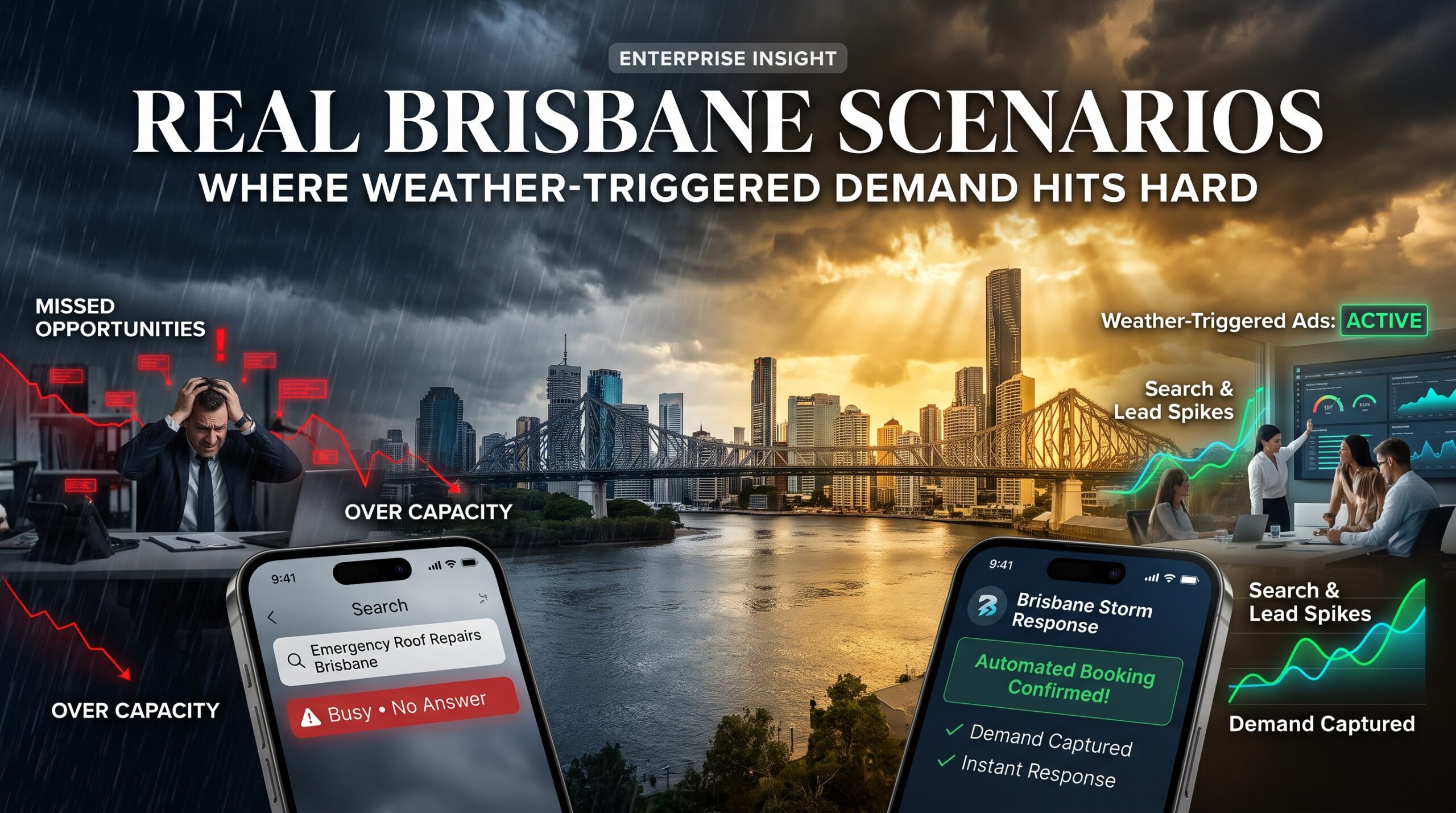
Storm season: roofing, plumbing, electrical and tree work
A hailstorm rolls through the northern suburbs and, by the next morning, searches like “storm damage repair near me”, “emergency roof repair Brisbane” and “tree removal after storm” are climbing. Trades that have pre-approved storm campaigns capture those enquiries. Trades waiting on the next monthly marketing meeting watch them go by.
Heatwaves: air conditioning, pools and cooling
When a run of 35-degree days is forecast, people suddenly remember their air conditioner is tired. Searches for “air conditioning repair Brisbane same day”, “pool supplies near me” and “portable fans” build days before the heat peaks. The smart move is to be visible as the forecast changes, not after the first complaint.
Wet weekends: cafés, indoor venues and food delivery
A grey Saturday sends families looking for “things to do in Brisbane when it rains” and “indoor activities for kids Brisbane”. Cafés, cinemas, play centres and delivery brands that show up with a timely offer win the day. Those with generic ads don’t.
Floods and clean-up: restoration, mould and pest control
After heavy rain, demand shifts again. People search for “water damage restoration Brisbane”, “mould removal” and “skip bin hire”, and pest controllers see a jump in termite and mosquito enquiries. The weather-triggered demand doesn’t end when the rain does; it changes shape, and your marketing should follow it.
Why Brisbane Businesses Keep Missing Weather-Triggered Demand
It’s rarely laziness. It’s usually structure. Here are the six causes we see most often:
- Monthly planning in a daily-demand world. Campaigns are set once and reviewed at month’s end, long after the storm has passed.
- Approval bottlenecks. New ad copy needs three sign-offs, and by the time it’s live the opportunity is gone.
- Budgets and schedules that don’t flex. Spend is capped evenly across the month, so the one day that matters gets the same budget as a quiet Tuesday.
- Copy that ignores the moment. Generic ads don’t speak to a customer who is standing in a wet hallway.
- Local listings out of sync. Hours, services and photos on Google Business Profile don’t reflect what you’re offering this week.
- Marketing disconnected from capacity. Ads keep running when the crew is booked solid, or switch off when there’s room for ten more jobs.
High-Intent Searches That Spike With the Weather
The searches below are the kind of high-intent queries that jump when conditions change. Use them as a starting point for keyword research, then validate volumes in Google Keyword Planner and your own Search Console data.
| Industry | Example high-intent searches | Weather trigger |
| Roofing and restoration | emergency roof repair Brisbane; storm damage repair near me; roof leak repair | Storms, hail, heavy rain |
| Plumbing and drainage | blocked drain Brisbane; burst pipe emergency plumber; stormwater drain repair | Flash flooding, heavy rain |
| Electrical | power outage electrician Brisbane; storm damage electrician; 24 hour electrician | Storms, lightning |
| Air conditioning | air conditioning repair Brisbane same day; split system service near me | Heatwaves |
| Pools and outdoor | pool shop near me; green pool fix; pool cleaning Brisbane | Heat, then heavy rain |
| Tree and garden | tree removal after storm Brisbane; fallen tree removal; garden clean-up | Storms, strong winds |
| Hospitality and leisure | things to do in Brisbane when it rains; indoor activities for kids Brisbane | Wet weekends, cool snaps |
| Restoration and pest | mould removal Brisbane; water damage restoration; termite inspection | Post-flood, humid weeks |
How to Close the Weather-Triggered Demand Gap: 7 Practical Steps
- Map your triggers. Look back over the last two or three years of calls, form fills and sales. Which weather events moved the numbers? Match those dates against Bureau of Meteorology records so you know your top three triggers.
- Build “always-ready” campaigns. Write storm, heatwave and wet-weather ad groups in advance, get them approved, and keep them paused until needed. The decision then becomes a switch, not a project.
- Automate the trigger. Google publishes a weather-based campaign management script that reads local conditions and adjusts campaign bids automatically. It’s a useful starting point if you’d rather not babysit forecasts.
- Bid for the moment, by suburb. When a storm cell hits Ipswich, Logan or Moreton Bay, lift bids and budgets for those areas and for emergency keywords, then ease off when the spike fades.
- Write ads like a human in a hurry. “Roof leaking? Same-day callouts across Brisbane” beats “Quality roofing solutions” every time. Mention the weather, the speed and the next step.
- Sync your local presence. Update opening hours, add a Google Business Profile post about emergency availability, and publish a dedicated page such as “Storm Damage Repair Brisbane” that matches what people are actually searching.
- Make converting effortless. Add tap-to-call, call tracking, a short form and, where you can, after-hours answering. A stressed customer will not fill in a ten-field form.
Google Ads for Weather-Triggered Demand: A Simple Framework
You don’t need a giant account to start. A lean structure works well: one campaign for emergency and storm searches, one for heat or cooling, and one for evergreen services. Keep your best-performing phrase and exact-match keywords in the emergency campaign, add strong negatives to avoid wasted clicks, and attach call, location and sitelink assets so your ads take up more space.
The real edge is speed. If your ads can switch on, scale up and carry weather-aware copy within the hour, you’ll outpace competitors who are still waiting on a monthly review. Our Google Advertising team builds exactly this kind of rapid-response setup, and you can see how engagements are structured in our Google Advertising packages.
Local SEO: Be Found Before the Storm Arrives
Paid ads capture the spike, but organic visibility earns trust and keeps costs down over time. Publish helpful, evergreen content ahead of the season: a storm preparation checklist for Brisbane homes, what to do after hail damage, how to cool a Queenslander during a heatwave. When the weather-triggered demand arrives, those pages are already indexed, already ranking and already answering questions.
This is where SEO, content marketing and a fast, mobile-friendly site work together. A strong website design and SEO foundation makes sure the visitor who finds you at 5pm during a storm can call you in a single tap.
Measuring Whether You’ve Closed the Gap
Track a handful of numbers and you’ll know quickly whether your weather-triggered demand strategy is working:
- Response time: How long between an enquiry and a real human reply?
- Calls and leads by hour: Are storm-day spikes being captured or missed?
- Cost per lead on trigger days versus normal days: Are you paying a fair premium for urgent demand?
- Impression share lost to budget: If this is high on storm days, your budget is cutting you off just as demand peaks.
- Search Console queries: Which weather-related terms are growing, and do you have pages for them?
Annotate your analytics with major weather events so next year’s planning starts with real evidence, not guesswork.
Weather-Triggered Demand Beyond Brisbane
Every Australian city has its own weather rhythm. The Gold Coast and Sunshine Coast share Brisbane’s storm and flood patterns. Sydney deals with east coast lows and sudden downpours, Melbourne is famous for four seasons in one day, Perth battles long summer heat, Adelaide sees sharp heatwaves, and Canberra swings from frosty winters to hail-prone summers. The playbook is the same everywhere: know your triggers, prepare your campaigns, and respond faster than the competition. You can explore all our locations to see how we support businesses nationwide.
Weather-Triggered Demand FAQs
What is weather-triggered demand in marketing?
It’s a short, sharp rise in customer searches and purchases caused by a weather change, such as a storm warning, heatwave or flood. Because intent is urgent, the businesses that respond first usually win the job.
Can I run Google Ads based on the weather?
Yes. You can adjust bids, budgets and ad copy manually when conditions change, or use Google Ads scripts that pull weather data and update campaigns automatically. Always test changes on a small budget first.
Which Brisbane industries are most affected?
Roofing, plumbing, electrical, tree services, air conditioning, pools, restoration, pest control and hospitality all see strong swings. If your sales jump or drop when the forecast changes, you’re affected.
How fast should I respond to a storm-driven enquiry?
As fast as you realistically can. Aim for minutes, not hours. Fast phone answering, instant form replies and clear after-hours messaging all help.
How much does a weather-triggered campaign cost?
It depends on your industry, competition and budget. Our marketing packages outline typical engagement levels, and a free review will give you a realistic starting point.
Final Thoughts: Be There When the Weather Turns
Weather-triggered demand will keep arriving in Brisbane whether your marketing is ready or not. The businesses that win aren’t luckier; they’ve simply shortened the distance between the forecast and the first ad, the first listing update and the first answered call. Start with one trigger, one ready-to-go campaign and one fast response process, then build from there.
Want help closing the gap? Read more on our blog, learn about us, or contact the team for a free marketing review. If you’d rather upskill your in-house team first, a structured digital marketing course is a solid way to build the fundamentals.