


Zero-click local search is what happens when a customer searches on Google, sees your business, gets what they need, and never opens your website. They might call you straight from the listing, tap for directions, or read your reviews and book somewhere else. Either way, your analytics show nothing. For many Brisbane businesses this is now the quiet reason enquiries feel inconsistent even though “visibility” looks fine.
Picture a Tuesday afternoon in Fortitude Valley. Someone types “emergency plumber near me” into their phone. Google shows a map and three businesses. One of them is yours. The customer taps the green call button on the middle result, speaks to someone for ninety seconds, and the job is booked. No website session. No form fill. No trace in your reports, apart from a phone ringing. That is zero-click local search working in your favour, if you notice it. If you do not, it looks like a marketing channel that is not working.
This guide explains what zero-click local search means for Brisbane businesses, how to measure the customers you cannot see in Google Analytics, and how to make the Google listing do more of the selling. It also covers when you do need the website visit, and how to earn it. If you would like a specialist team to audit your local visibility, our local SEO and SEO services are built for exactly this.
What Is Zero-Click Local Search?
A zero-click search is any search where the person gets their answer on the results page and does not click through to a website. Google has spent years improving the results page so it can answer more questions itself. For local intent, that means maps, business profiles, star ratings, opening hours, photos, quick-action buttons and, increasingly, AI-generated summaries.
Zero-click local search is the same idea applied to “near me” and suburb-level queries. The customer has already decided they want a business like yours. They only need confirmation that you are open, nearby and trusted. If the listing provides that, there is little reason to visit your site first.
That is not a bug. Google designed it to be quick. The problem is that most Brisbane businesses still measure success by website traffic, so they judge a healthy channel as a failing one.
Why Zero-Click Local Search Matters for Brisbane Businesses
Brisbane is a spread-out city. People search from the car, from a worksite in Springwood, or from a lunch break in the CBD. Mobile searches with local intent often end in a call or a navigation request rather than a long browsing session. Trades, clinics, cafes, salons, legal practices and home services are all affected.
There are three business consequences worth understanding.
- Reports undercount your real demand. Calls, direction requests and messages from your Google listing do not appear as website sessions, so traffic can fall while enquiries hold steady, or the reverse.
- You may cut the wrong channel. If a campaign “does not bring traffic”, it is easy to pause it, even when it is generating phone calls.
- Your listing becomes your first impression. For many customers the Google profile is the shop front. Weak photos, thin reviews or wrong hours cost you the lead before you ever get a chance to pitch.
What Customers Do Instead of Visiting Your Website
Each of these actions is a conversion in the customer’s mind. Most are invisible in a standard website report unless you set up tracking for them. The table shows what to look for and how to measure it.
| Zero-click action | What it tells you | How to track it |
| Phone call from the listing | High-intent customer ready to book | Business Profile call reports, call tracking number, call assets in Google Ads |
| Direction request | Customer is planning to visit in person | Business Profile direction reports, compare with foot traffic |
| Reading reviews | Customer is comparing you with competitors | Review count, average rating and recency, tracked monthly |
| Photo and menu views | Customer is judging quality and fit | Business Profile photo views against competitors |
| Message or booking tap | Customer wants a quick answer without calling | Business Profile messaging or booking link with UTM tags |
| Featured snippet or AI summary | Customer got the answer from Google, possibly with your name cited | Search Console impressions with low clicks, brand mention checks |
Is Zero-Click Local Search Bad for Your Business?
Not necessarily. A customer who calls from your listing is often more valuable than one who browses your site for five minutes and leaves. The danger is not the behaviour itself, it is being blind to it.
Zero-click local search becomes a real problem in three situations:
- Your listing is being seen but not chosen, which means impressions are high and calls are low.
- A competitor’s listing looks stronger, so they take the call even when you ranked higher.
- The customer needs more information than the listing provides, such as pricing, service areas or credentials, and your website is not there to close the gap.
Fixing each of these starts with the same step: treat the Google listing as part of your marketing funnel, not as a side task.
How to Measure Customers You Cannot See in Analytics
You cannot improve what you cannot count. These steps take a few hours to set up and change how you see local performance.
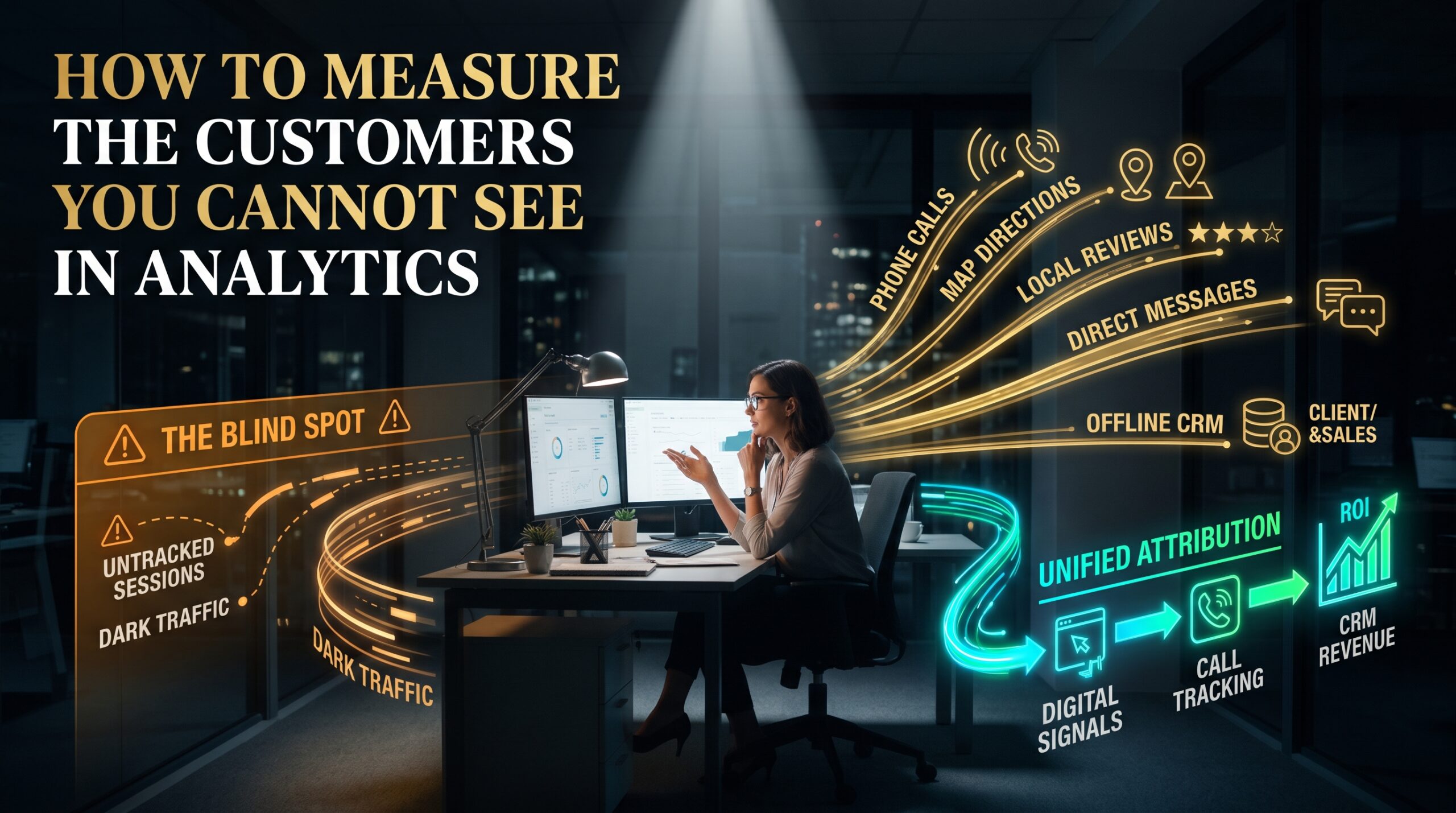
1. Use Google Business Profile performance reports
Your Google Business Profile shows how many people called, requested directions, visited the website or messaged you. Record these monthly in a simple sheet so you can see trends instead of single numbers.
2. Add UTM tags to your listing links
Put a tracking tag on the website and appointment links in your profile. In Google Analytics 4 you can then separate listing traffic from regular organic search, which shows how many of your clicks come from the map pack.
3. Use a dedicated tracking phone number
Call tracking shows which channel produced a phone call and, with recording where lawful, what the call was about. Keep your main number as a secondary line on the profile so local consistency is not affected.
4. Track branded and suburb searches in Search Console
Rising impressions for “your business name” and “service + suburb” searches, with flat clicks, is a typical zero-click pattern. It tells you people are finding you and getting answers from the results page.
5. Ask every new customer how they found you
It is old-fashioned and it works. A single question on the booking form or phone script captures what no report can.
How to Win More Enquiries From Zero-Click Local Search
Once you can see the behaviour, you can shape it. The aim is to make your listing so convincing that the call or booking happens there, and to make your website worth visiting for the customers who do want more detail.
Make your Google listing do the selling
- Choose accurate primary and secondary categories, because they decide which searches you appear in.
- List every service with a clear description and, where possible, a starting price or range.
- Upload real photos of your team, premises and finished work, and refresh them regularly.
- Keep opening hours, holiday hours and service areas current. A wrong hour is a lost call.
- Add a booking or enquiry link that goes to a fast, focused landing page.
Build review volume and respond to every review
Reviews are the strongest trust signal in a zero-click local search. A business with fewer, older reviews often loses the call to a competitor with fresher ones, even when it ranks higher. Ask happy customers at the right moment, reply politely to every review and use the language customers use, because it feeds back into relevance.
Keep your name, address and phone number consistent
Inconsistent business details across directories confuse both customers and search engines. Use the same name, address and phone format on your website, your profile and major directories. Marking up your site with LocalBusiness structured data helps Google understand who you are and where you operate.
Give your website a job the listing cannot do
When someone does click through, they usually want depth: proof of past work, detailed pricing, team credentials, FAQs. Build suburb and service pages that answer those questions properly. Our website design and SEO service focuses on pages that convert the visitors who do arrive, and our content marketing team writes the helpful answers that earn clicks beyond the snippet.
Support the listing with paid local visibility
Paid search can sit above the map pack and reinforce your name. Location assets, call assets and well-structured campaigns capture high-intent customers when organic positions are crowded. If you want help structuring them, see our Google Advertising service and Google Advertising packages.
Zero-Click Local Search Across Brisbane Suburbs
The pattern looks different from suburb to suburb. Here is how the behaviour typically shows up, and where to focus.
| Brisbane area | Typical zero-click behaviour | Where to focus |
| Brisbane CBD | Lunch-time and after-work searches for services, cafes and professional offices | Accurate hours, strong photos, fast calls and bookings |
| Fortitude Valley | Late-opening hospitality, creative and beauty services compared quickly on mobile | Reviews, recent photos and clear opening hours |
| South Bank | Visitors and residents searching for food, wellness and events | Direction requests, menu or service details and visitor reviews |
| Chermside | Family and retail searches from drivers and shoppers | Suburb landing pages, call tracking and review volume |
| Indooroopilly | Education, health and professional services compared before booking | Credentials, service pages and appointment links with tracking |
| Springwood | Trades and home services searched on the go for urgent jobs | Call-first listings, service areas and fast response |
Our team supports local businesses with SEO packages designed around suburb-level visibility, and you can read about our work on the Brisbane digital marketing page.
Common Mistakes That Make Zero-Click Local Search Worse
- Judging local SEO only by website sessions.
- Leaving an unclaimed or half-completed Google profile.
- Using a different phone number or business name across directories.
- Ignoring negative reviews, which signals indifference to future customers.
- Sending listing traffic to the generic home page instead of a relevant landing page.
- Treating paid ads and local SEO as separate projects instead of one visibility system.
A 30-Day Plan to Turn Visibility Into Enquiries
- Week 1: Audit your Google listing, correct categories, hours, services and photos, and set up UTM tags and a tracking number.
- Week 2: Start a review request routine and respond to every existing review.
- Week 3: Build or improve landing pages for your top services and suburbs, with clear calls to action and structured data.
- Week 4: Review your Business Profile reports, Search Console and call data together, then adjust. Consider adding a paid local campaign where competition is strong.
If you would rather have specialists handle it, you can request a free review and we will show you where customers are finding you without clicking.
For marketers who want to learn the skills in depth, Logitrain also offers a digital marketing course covering search, analytics and paid media.
Frequently Asked Questions About Zero-Click Local Search
What does zero-click local search mean?
It means a customer searches for a local business, finds the information they need on the Google results page or map, and takes action without visiting the business website. Typical actions are calling, requesting directions or reading reviews.
Does zero-click local search hurt my SEO?
It does not directly hurt rankings, but it lowers website click-through and can make your reports look weaker. Measuring calls, directions and listing actions gives a more accurate view of performance.
How can I track calls and directions from Google?
Use the performance reports in your Google Business Profile, add UTM tags to listing links, and use a tracking phone number. Combine these with Google Analytics 4 and Search Console for a complete picture.
Do I still need a website if customers call from Google?
Yes. Many customers want pricing, proof and detail before they commit, and your website supports your listing, your ads and your credibility. A strong site also helps your profile rank.
How long does it take to improve local visibility in Brisbane?
Profile and review improvements can show results within weeks. Competitive suburb rankings usually take a few months of consistent work. Results vary by industry and competition.
You can find more answers on our FAQs page or browse the blog for further guides.
Final Thoughts: Visibility Without Visits Is Still Revenue
Zero-click local search is not the end of the website. It is the end of using website visits as the only proof that marketing works. Brisbane customers are finding you on Google, forming a view in seconds and acting there and then. When you measure those moments and improve them, the enquiries start to match the visibility you already have.
Ready to see what is really happening on your listing? Talk to the team at Digital Marketing Agency Brisbane on 1300 649 299, or explore our services and city pages for Melbourne, Sydney, Perth, Adelaide and Canberra.